Platform

Everything behind governed LLM traffic

Integrations, agent tracing, catalogue governance, SDK, architecture, and use cases — for teams that need depth beyond the homepage.

Agentic AI observability

Control and trace cascading agent AI workflows

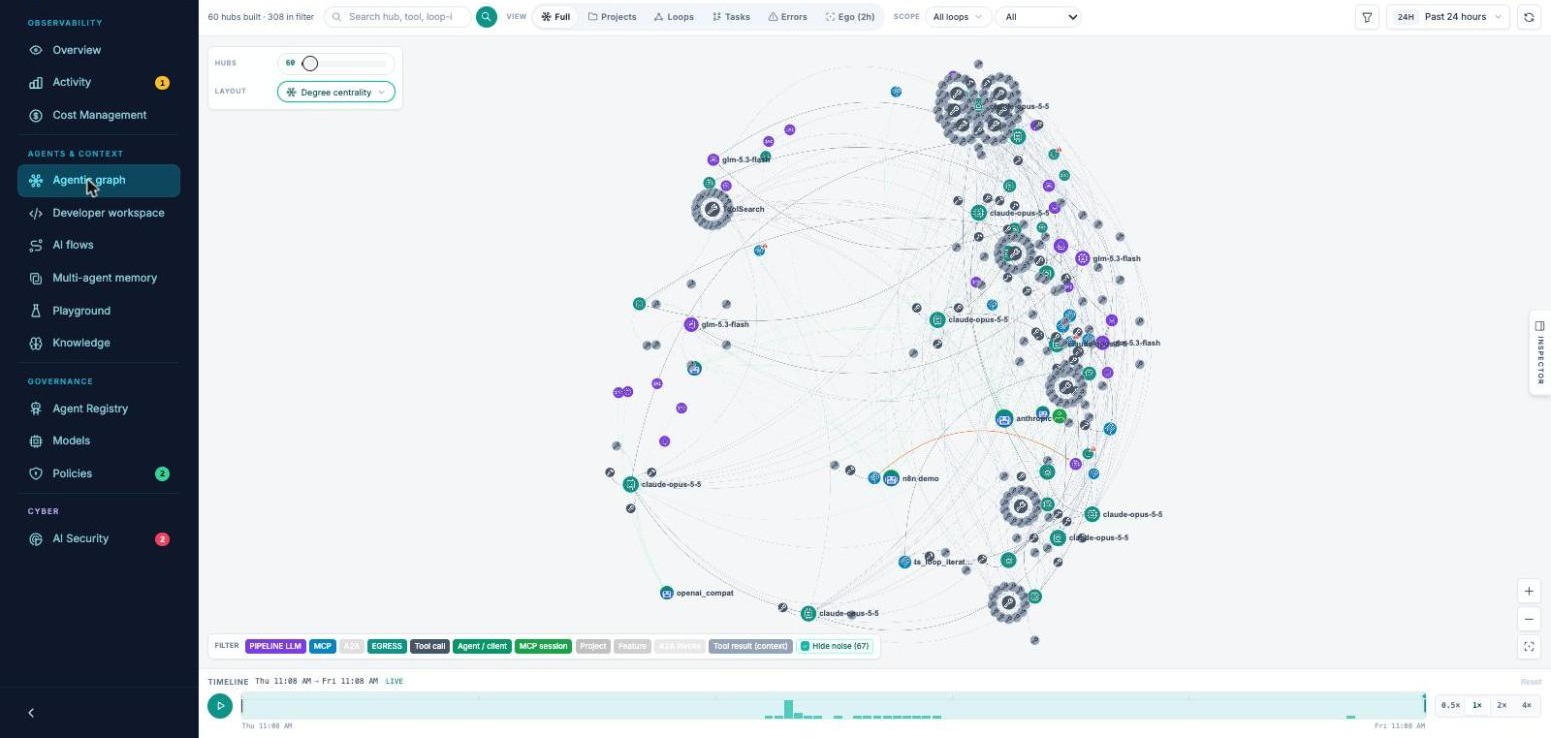
From a single prompt to multi-step agents calling tools — and agents delegating to other agents — TokenSaver secures and records every exchange. See the full run graph: cache, RAG, compression, PII, LLM calls, and tool results in one trace timeline, with cost, latency, and policy outcomes per step.

  • End-to-end visibility on agentic architectures — orchestrators, sub-agents, and tool-assisted runs in one dashboard
  • Governance on every hop: org-scoped keys, quotas, PII controls, and audit-ready metrics — not just the final model reply
  • Stack-agnostic: route any client through the same governed pipeline — code-first or low-code / no-code

Works with your stack

LangChainLangGraphCrewAIn8nMakeZapierOpen WebUILibreChat

Unified control plane

Govern every LLM through one platform layer

TokenSaver sits in front of your vendor APIs: the same policies, catalogue, metering, and pipeline run whether traffic comes from the console, an OpenAI-compatible client, or the native API — so models stay under control as you add providers and scale usage.

  • 7LLM providers routed
  • 261+LLM models governed (chat & embeddings)
  • 1Pipeline — cache, RAG, compression, PII, then model
  • 3Ways in — console, OpenAI-compatible HTTP, native API & SDK

Catalogue-backed calls

Every provider and model pair is checked against the same live catalogue the console uses — no shadow lists or one-off client configs.

Org-scoped governance

Workspace keys, quotas, and spend views anchor on TokenSaver — vendor credentials stay on the platform while teams keep a single place to enforce access and budgets.

Same modules, any vendor

Semantic cache, retrieval, compression, and PII controls run in a fixed order before the upstream model — so optimization and safety don't depend on which provider answers the call.

Observable by design

Traces and metrics across pipeline steps give platform and security teams visibility into cost, latency, and policy outcomes — not just raw model output.

Explore the public model catalogue or call GET /api/v1/llm-reference/models for the authoritative list for your environment.

How you connect

One governed pipeline — three ways to integrate

Whether your teams live in chat UIs, IDEs, or custom backends, you land on the same TokenSaver path: cache, RAG, compression, PII, then the model — with org-scoped keys, quotas, and dashboards. Pick the surface that matches your stack; no duplicate policy layers.

  • Same module order & observability
  • One TokenSaver API key per workspace
  • Provider keys stay on the platform

The platform reference catalog spans 7+ providers (OpenAI, Anthropic, Google Gemini, Mistral, Grok, DeepSeek) and 261+ LLM models (chat and embeddings). Same model / provider pairs the native and OpenAI-compatible APIs validate against GET /api/v1/llm-reference/models.

OpenAI-compatiblehttps://api.tokensaver.fr/openai/v1Chat Completions, Responses API, models (all routed providers), embeddings
Native TokenSaver APIhttps://api.tokensaver.fr/api/v1Pipelines, RAG, chats — Python SDK & custom apps

No-code · Chat tools

OpenAI-compatible UIs

Connect LibreChat, Open WebUI, and other tools that accept a custom OpenAI base URL. Set base URL to …/openai/v1, use your TokenSaver API key as Bearer, and optional X-Tokensaver-* headers to tune cache, RAG, compression, and PII per request, or X-Tokensaver-Apply-Key-Pipeline-Defaults to reuse pipeline defaults saved on the API key — no fork of your client required.

OpenAI-compatible docs

Console · Teams

TokenSaver Platform

The hosted app for operators and builders: governed chat, dashboard and spend views, model pricing, API keys, pipeline defaults, and in-product docs. Ideal when you want clicks, not config files — still the same pipeline the APIs run.

Open the console

Developers · Code

Native API & Python SDK

POST /api/v1/pipelines/run, typed tokensaver-sdk on PyPI, and the same reference your workspace shows after sign-in. Pick any catalog-backed provider/model pair — 261+ LLM models across 7+ vendors in the reference catalog. Best when you need fine-grained requests, agents, or CI — governance and metering match the console and OpenAI-compatible traffic.

Provider-agnostic — use the models you already trust

Same governance, optimization, and security layer in front of OpenAI, Anthropic, Google Gemini, Mistral, Grok, DeepSeek, and more — route and compare 261+ catalog models without duplicating policies or losing cost visibility.

Built for the move from pilot to production: one control plane as usage, providers, and internal stakeholders grow.

Platform

What's powering TokenSaver

Four capabilities that work together — not a pile of disconnected APIs. Configure once, override per request when you need to.

Product teams get business value fast; platform and security teams keep governance, spend control, and reliability as adoption scales.

Pipeline console

A single workspace to tune cache thresholds, RAG depth, compression level, and PII policies — aligned with what the API actually runs.

Learn more

AI observability (OpenTelemetry)

Instrument LLM traffic with OpenTelemetry-friendly traces and metrics across every pipeline step. Expose the same signals to Prometheus and Grafana for alerting, SLOs, and cost or latency dashboards your platform team already runs.

Learn more

RAG & knowledge

Ingest PDFs and retrieve grounded chunks with multimodal-ready storage — context that stays scoped to the right user and workspace.

Learn more

Trust by design

Data sensitivity by design: automatic PII detection and configurable anonymization or redaction on every exchange, so regulated or personal content is stripped before it reaches model APIs. Harden data flows against accidental leakage to LLMs and downstream logs while you scale usage with confidence.

Learn more

Intelligent routing

One governed path from prompt to model response

Every call flows through the same modules — so you optimize tokens, enforce guardrails, and keep audits simple. Swap providers without losing cost signals or safety posture.

Get free access

Lifecycle tools

Tools to manage the full request lifecycle

Test overrides, inspect per-step metrics, and correlate runs with traces — low-friction operations for platform teams and app owners alike.

See use cases

Architecture

Trusted pipeline architecture

Embed anywhere your apps run — console, OpenAI-compatible clients, or native API / SDK — supervise usage centrally, enforce org boundaries, and keep provider keys off end-user devices.

Custom apps and agents use the native API; LibreChat, Open WebUI, and similar tools use the OpenAI-compatible base path — one product behind both.

Developers · Open source

Python SDK on PyPI — LangChain & LangGraph, extended with TokenSaver governance

tokensaver-sdk is open source (MIT) and free for the open-source community, published on PyPI. TokenSaver builds on LangChain and LangGraph to run governed LLM pipelines and adds a governance overlay on top — access control, budgets, semantic cache, RAG, compression, PII policies, and observability. The SDK is the HTTP client to that stack: same behaviour and limits as the console, whether you trigger runs from code or the UI.

Orchestration inside the platform leans on LangChain / LangGraph patterns; TokenSaver enforces policy and cost before traffic reaches commercial model APIs.

pip install tokensaver-sdkMIT License

Use cases

TokenSaver powers critical LLM workflows

Same pipeline, different jobs — customer-facing or internal.

Customer support

Grounded answers with RAG, redacted transcripts with PII policies, and cache for repeat intents.

Benefit: Lower cost per ticket, faster replies.

Internal copilots

Central keys, workspace isolation, and spend visibility across teams — without shadow IT keys.

Benefit: Governance without blocking builders.

Research & docs

Long-context compression before the model call, retrieval over your knowledge base, full run history.

Benefit: Deeper context, controlled spend.

Analytics & data apps

Trace IDs, token and cost breakdowns, export-friendly metrics for FinOps and security reviews.

Benefit: One source of truth for LLM spend.

Trust

Trusted operations, built in

Guardrails and visibility that stay aligned as you scale traffic.

Pipeline guardrails

Fixed module order, plan-aware feature flags, and configurable PII strategies — reduce drift between environments.

Data boundaries

Org-scoped provider keys, user-scoped cache and retrieval, and masking before payloads leave your policy boundary.

Observability

Per-run steps, cache hit types, RAG attribution hooks, and OTel — so incidents are short and audits are boring.

Getting started

From API key to governed rollout

1
Foundation

Connect providers once, control access centrally

Register OpenAI, Anthropic, Google, or Mistral keys at org level. Applications call TokenSaver only, so provider credentials stay off app servers and client devices.

Outcome: one secure gateway for all teams and environments.

2
Optimization

Set smart defaults to reduce spend and drift

Define governed defaults for semantic cache, RAG, compression, and PII controls. Keep safe per-request overrides for advanced cases, without losing consistency.

Outcome: lower token cost, predictable behavior, faster delivery.

3
Scale

Monitor cost, quality, and security in real time

Track usage, spend, cache hit types, and step-by-step traces in one place. Detect anomalies quickly and provide audit-ready visibility for platform, security, and finance teams.

Outcome: confident rollout across products, teams, and providers.

Explore more

Frequently asked questions

What is an LLM gateway?

A single API and policy layer in front of multiple model providers. Your applications call TokenSaver; TokenSaver applies cache, retrieval, compression, and safety, then calls the right model with your org's keys.

Can I use LibreChat, Open WebUI, or other OpenAI-compatible clients?

Yes. Configure the client's OpenAI base URL to point at TokenSaver's OpenAI-compatible path (…/openai/v1), and authenticate with your TokenSaver API key. The same governed pipeline runs as for the console and the native API; optional X-Tokensaver-* headers adjust cache, RAG, compression, and PII per request. Code examples: OpenAI-compatible docs.

How does TokenSaver optimize tokens and secure prompts?

TokenSaver runs an ordered pipeline: semantic cache, retrieval on your local RAG, compression of injected context, then sensitive-data detection and anonymization (PII) before the LLM call. You cut billed tokens while controlling personal and confidential data sent to models. Same behavior via console, native API, or OpenAI-compatible path — with quotas and monitoring. See plans on Pricing.

Can I self-host?

The platform is designed for both cloud SaaS and self-managed deployments — keep data and keys inside your perimeter when required.

How does billing visibility work?

Runs record tokens, estimated cost, and cache outcomes so finance and engineering can reconcile usage without exporting raw logs.

Is the pipeline order fixed?

Yes — cache, RAG, compression, PII, then LLM, then metrics. That predictability is what makes debugging and compliance reviews tractable.

Is there a Python SDK? Does it work with LangChain or LangGraph?

Yes. tokensaver-sdk is open source (MIT), free to install from PyPI. It calls the TokenSaver HTTP API: the product uses LangChain and LangGraph as part of its pipeline implementation and layers governance (cache, RAG, compression, PII, quotas, observability) on those foundations — you integrate from Python without re-implementing that stack yourself.